
In today’s competitive UK market, spiralling fuel costs and the high price of a single late delivery can significantly impact your bottom line and damage your hard-earned reputation. If chaotic dispatch processes, a lack of shipment visibility, and unreliable delivery times are eating into your profits, you are not alone. The key to overcoming these obstacles and gaining a decisive competitive advantage lies in mastering your logistics efficiency.
This practical guide provides actionable strategies to transform your supply chain. We will show you how to streamline your operations from the warehouse to the final destination, significantly reduce delivery costs, and ensure your products reach customers faster and more reliably. By implementing these expert insights, you can create a predictable and scalable logistics process that enhances customer satisfaction and delivers the peace of mind that comes with a truly efficient system.
Key Takeaways
- Understand that true logistics efficiency goes beyond cost-cutting to directly protect your brand reputation and build customer loyalty.
- Discover the three core pillars of logistics-Transportation, Warehousing, and Information-and learn how optimising one area improves the others.
- Implement actionable strategies, suitable for any UK business, to streamline your operations and reduce delivery delays immediately.
- Learn which Key Performance Indicators (KPIs) are essential for measuring your logistics performance, so you can make data-driven improvements.
- Find out how partnering with a specialist courier provides a strategic advantage that goes far beyond simple parcel delivery.
What is Logistics Efficiency (And Why It’s Critical for UK Businesses)
At its core, logistics efficiency is a simple but powerful concept: delivering the right item, to the right place, at the right time, and for the right cost. While the broader field of What is Logistics encompasses the entire flow of goods, efficiency is the measure of how well that flow is executed. It’s the critical difference between a chaotic, wasteful operation and a streamlined, professional one-much like the contrast between a disorganised home kitchen during a holiday rush and the calm, precise operation of a Michelin-starred restaurant.
For UK businesses, achieving this efficiency is not just an advantage; it’s a necessity. Companies face a unique set of pressures, from navigating congested city centres in London and Manchester to managing the ever-rising cost of fuel. Add to this the high customer expectations for fast, often next-day, delivery, and it becomes clear that an inefficient logistics process is a significant liability. It directly impacts your bottom line, your customer loyalty, and your brand’s reputation in a competitive market.
The True Cost of Inefficiency
A disorganised logistics process costs more than just money. The financial drains are direct and obvious-wasted fuel on poorly planned routes, overtime pay for drivers stuck in traffic, and the expense of processing returned parcels. However, the indirect costs are often more damaging: lost customers due to late deliveries, negative online reviews that deter new clients, and the hidden cost of senior management time spent resolving delivery issues instead of focusing on business growth.
Key Benefits of an Efficient Logistics Process
Investing in a streamlined, reliable logistics framework delivers tangible returns that go far beyond simple cost savings. A commitment to an efficient process provides peace of mind and fuels sustainable growth.
- Lower Operational Costs: Through optimised routing, better vehicle utilisation, and reduced administrative errors, you can significantly cut expenses on fuel, wages, and returns.
- Increased Customer Satisfaction: Delivering on time, every time, is the cornerstone of customer trust. Reliable deliveries lead to repeat business and positive word-of-mouth.
- Improved Scalability: An efficient system is built to grow with you. As your order volume increases, your logistics can scale seamlessly without descending into chaos.
- Enhanced Brand Image: Your delivery service is a direct reflection of your company. A professional, reliable delivery experience positions your brand as one that customers can depend on.
The Core Pillars of an Efficient Logistics Operation
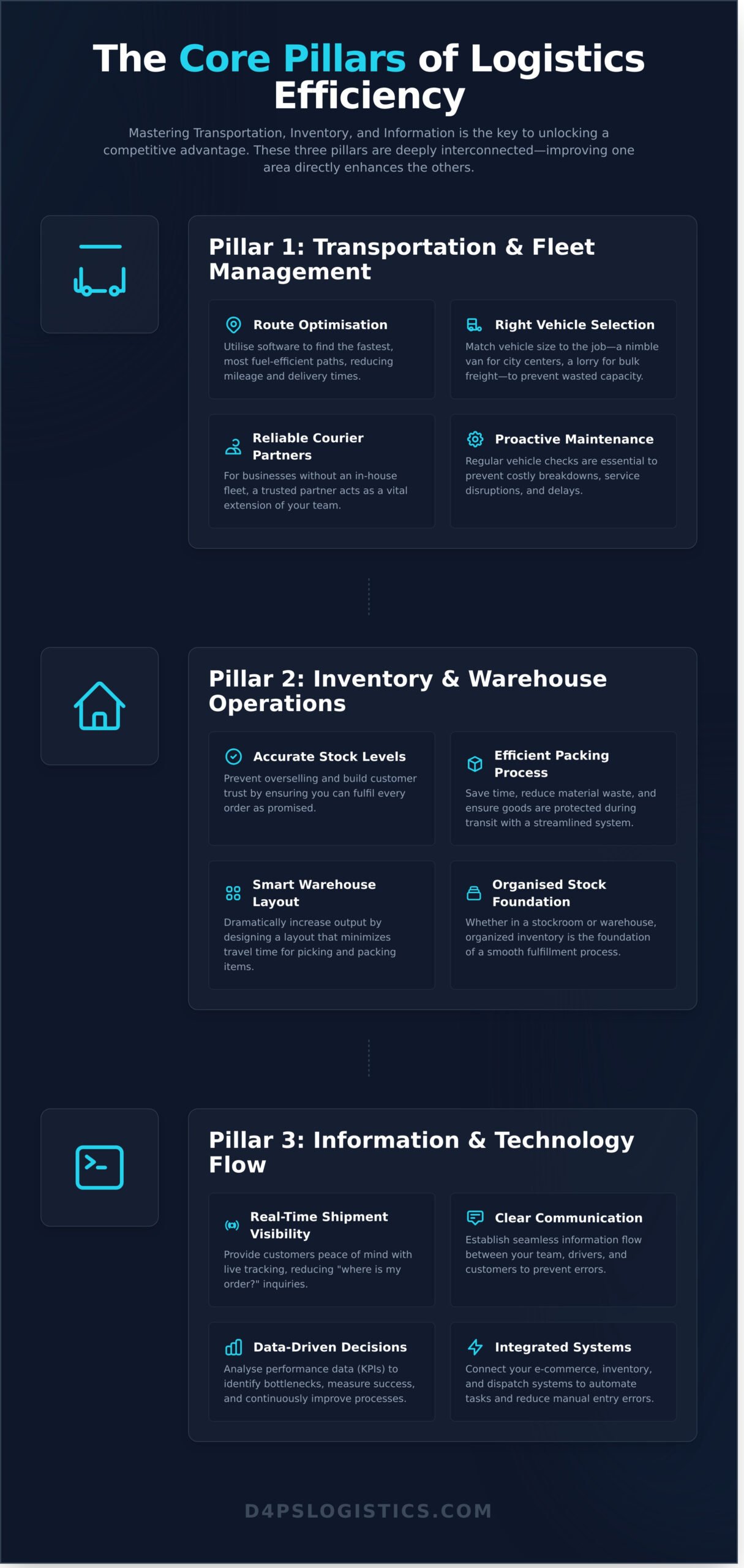
To truly enhance your business’s performance, it’s crucial to understand the three core pillars of an efficient logistics operation: Transportation, Inventory, and Information. These elements are deeply interconnected; an improvement in one area, such as smarter inventory management, directly reduces transportation costs and improves data accuracy. Achieving high levels of logistics efficiency is more than an operational goal; as academic studies show, it is a key differentiator that provides a Competitive Advantage of Logistics Efficiency. Use the following points as a checklist to audit your current processes.
Pillar 1: Transportation and Fleet Management
This pillar covers the physical movement of your goods. Success here depends on using the right tools for the task. Selecting the appropriate vehicle-a nimble van for city-centre deliveries versus a larger lorry for bulk freight-prevents wasted capacity and fuel. Route optimisation software ensures drivers take the fastest, most cost-effective paths, reducing mileage and delivery times. For businesses without an in-house fleet, a reliable courier partner becomes an extension of your team, while proactive vehicle maintenance is essential to prevent costly breakdowns and delays.
Pillar 2: Inventory and Warehouse Operations
Even if you operate from a small stockroom instead of a large warehouse, managing your inventory is critical. Accurate stock levels prevent overselling and ensure you can fulfil orders as promised, building customer trust. An efficient packing process not only saves time but also reduces material waste and protects goods during transit. For businesses with dedicated storage, a smart layout that minimises travel time for picking and packing can dramatically increase output. The core principle remains the same for any size operation: organised stock is the foundation of a smooth fulfilment process.
Pillar 3: Information and Technology Flow
Information is the glue that holds your logistics together. Clear, real-time communication between your sales team, operations, and the end customer is non-negotiable. Modern technology, such as live tracking software, provides essential visibility and peace of mind for all stakeholders. Furthermore, accurate data is vital for everything from correct order processing to generating flawless shipping labels. By analysing this data, you can effectively identify bottlenecks in your workflow and make informed decisions to continuously improve your overall operational performance.
Actionable Strategies to Dramatically Boost Your Logistics Efficiency
Improving your business’s delivery and transport operations doesn’t require a complete overhaul. By implementing a series of targeted, practical strategies, any company can achieve a significant boost in its logistics efficiency. The key is to combine smarter internal processes with the right external partnerships, creating a streamlined system that saves time, reduces costs, and enhances customer satisfaction.
Optimise Your Routes and Delivery Schedules
One of the most direct ways to improve efficiency is by refining how your vehicles move. Instead of single-destination trips, plan multi-drop routes that consolidate several deliveries into one journey. Use modern GPS and route planning tools to identify the most efficient sequence of stops. Where possible, schedule deliveries to avoid peak traffic times in congested areas. This simple act not only saves significant time and fuel costs but also reduces wear on your vehicles and minimises stress for your drivers.
Leverage the Right Technology for Your Needs
Technology is a powerful ally in optimising logistics. Start with a courier management software that allows for easy booking, management, and real-time parcel tracking. This visibility provides peace of mind for both you and your customers. Integrating an inventory management system can prevent stockouts and ensure products are ready for dispatch. You don’t need a complex enterprise system from day one; many scalable, cloud-based solutions offer powerful features. Modern platforms are now using advanced algorithms, with industry analysis on AI and Optimization in Logistics demonstrating how data is creating more agile and responsive supply chains.
Choose the Right Courier Partner
Your choice of courier is more than just a line item expense; it’s a strategic decision. A true logistics partner works with you to solve challenges, offering more than just the cheapest rate. Look for a provider who demonstrates:
- Reliability: A consistent track record of on-time, secure deliveries.
- Flexibility: The ability to handle unexpected requests or changes in volume.
- A Range of Services: Access to same-day, next-day, or specialist services when you need them.
Having a reliable partner with urgent delivery options can prevent a minor issue from becoming a major operational failure, making it a cornerstone of effective logistics efficiency. A reliable partner is key. See how D4PS Couriers & Logistics delivers peace of mind.
Measuring Success: Essential Logistics KPIs You Must Track
In business, there is a timeless saying: you can’t improve what you don’t measure. This is especially true for your supply chain, where even minor adjustments can yield significant results. To achieve greater logistics efficiency, you need a clear view of your performance. This is where Key Performance Indicators (KPIs) come in.
Think of KPIs as a scorecard for your operations, providing objective data on what’s working and where improvements are needed. Instead of getting overwhelmed by data, we recommend starting with 3-4 essential metrics that align with your business goals. By focusing on the following key areas, you can build a reliable framework for success.
Speed and Time-Based KPIs
These metrics measure how quickly and reliably you move goods from origin to destination.
- On-Time Delivery Rate: Calculated as (Number of On-Time Deliveries / Total Deliveries) x 100. This is arguably the most critical customer-facing metric, directly impacting client satisfaction and your business’s reputation.
- Order Cycle Time: The total time elapsed from the moment a customer places an order to the moment it is successfully delivered. Shorter cycles mean happier customers and more efficient cash flow.
- Vehicle Turnaround Time: Measures how quickly a vehicle can be unloaded and reloaded for its next journey. Minimising this time ensures your assets are always productive.
Cost and Financial KPIs
Understanding the financial impact of your logistics is essential for profitability.
- Cost Per Delivery: The total operational expense (fuel, labour, maintenance) divided by the number of successful deliveries. This KPI, measured in GBP (£), provides a clear picture of your per-parcel expenditure.
- Fuel Cost Per Mile: A crucial metric for managing fleet expenses in the UK. Tracking this helps identify inefficient vehicles or routes, leading to direct cost savings.
- Transportation Costs as a Percentage of Revenue: Calculated as (Total Transportation Costs / Total Company Revenue) x 100. This high-level metric shows how logistics spending impacts your overall profitability.
Quality and Accuracy KPIs
Speed and cost mean little if the quality of service is poor. These KPIs track performance and reliability.
- Order Accuracy Rate: The percentage of orders shipped without any errors (e.g., wrong item or quantity). A high rate reduces costly returns and builds customer trust.
- Delivery Exception Rate: Tracks the percentage of shipments that are late, damaged, or lost. A low rate demonstrates a reliable and secure delivery process, delivering peace of mind.
- Perfect Order Rate: The gold standard. This measures the percentage of orders delivered on time, complete, damage-free, and with correct invoicing. Excelling here is the hallmark of a truly efficient logistics partner.
How a Specialist Courier Unlocks Peak Efficiency for Your Business
While optimising internal processes is crucial, the true key to unlocking peak logistics efficiency lies in your choice of delivery partner. Generic, one-size-fits-all services often create more problems than they solve, leading to delays, damages, and wasted administrative time. A specialist courier, however, moves beyond simply transporting boxes. They become an integrated part of your operation, delivering not just parcels, but tangible business advantages.
By partnering with a dedicated courier service like D4PS Couriers & Logistics, you gain a tailored solution designed to address your specific operational challenges and elevate your service standards.
The Speed Advantage: Same-Day and Overnight Services
In today’s fast-paced market, speed is a competitive necessity. Urgent deliveries solve critical problems and create valuable opportunities. Imagine eliminating operational downtime by receiving a replacement part in hours, not days, or securing a vital contract by delivering documents before a deadline. For e-commerce businesses, offering same-day or guaranteed next-day delivery directly improves your ‘Order Cycle Time’ KPI, meeting and exceeding customer expectations. This level of responsiveness transforms logistics from a cost centre into a driver of growth.
Specialised Handling for Critical Sectors
True efficiency is about more than just speed; it’s about precision and security, especially when handling sensitive items. Generic carriers lack the training and protocols for high-stakes deliveries, which can lead to costly errors. A specialist understands the unique demands of different industries:
- Healthcare Logistics: Ensuring the secure, timely, and temperature-controlled transport of medical specimens and equipment where accuracy is paramount.
- Media and TV: Guaranteeing that expensive production equipment arrives safely and on time for a shoot, preventing costly schedule overruns.
- Professional Services: Providing a secure chain of custody for confidential legal or financial documents, mitigating the immense risk of a data breach.
Reliability as the Foundation of Efficiency
Ultimately, the greatest efficiency gain comes from reliability. A dependable courier partner eliminates the hours your team wastes chasing parcels, managing exceptions, and dealing with customer complaints. With proactive communication and real-time tracking, you gain complete visibility and peace of mind. This consistent, reliable performance allows you to plan your own operations with confidence, knowing your deliveries are handled correctly, on time, every time. This is the foundation upon which superior logistics efficiency is built.
Don’t let logistics slow you down. Get a quote for an efficient courier service.
Unlock Peak Efficiency: Your Final Step Towards Flawless Logistics
Achieving operational excellence is not a single action but a continuous commitment to improvement. As we’ve explored, it begins with understanding the core pillars of your supply chain, implementing targeted strategies from route optimisation to warehouse management, and diligently tracking key performance indicators. This structured approach transforms your logistics from a cost centre into a significant competitive advantage for your UK business, boosting customer satisfaction and your bottom line.
However, the fastest way to elevate your logistics efficiency is by partnering with a specialist who understands your unique demands. D4PS Logistics provides this decisive advantage, offering reliable, 24/7 Same-Day and Next-Day services. With specialist expertise in sectors like healthcare and e-commerce, we deliver on a simple promise: your items delivered securely and on time, every time.
Ready to streamline your operations and gain crucial peace of mind? Take the decisive step towards a more resilient and profitable future. Discover tailored courier solutions that boost your efficiency.
Frequently Asked Questions About Logistics Efficiency
What is the difference between logistics and supply chain management?
Logistics is a component of supply chain management. It refers specifically to the movement, storage, and delivery of goods and services. This includes warehousing, fleet management, and final delivery. Supply chain management is the broader framework that oversees the entire production flow of a product-from sourcing raw materials and manufacturing to delivering the final product to the consumer. In short, logistics is the ‘how’ and ‘when’ of moving goods within the larger supply chain.
How can a very small business improve its logistics efficiency?
Even the smallest businesses can take effective steps. Start by optimising your packaging to reduce size and weight, which can lower shipping costs. Consolidate shipments where possible to minimise the number of pickups. Partnering with a reliable, local courier service can provide access to efficient routes and technology without the overhead of managing your own vehicles. Using simple inventory management software also prevents stockouts and overstocking, ensuring a smoother operation from order to delivery.
What is the most important KPI for logistics efficiency?
While several KPIs are valuable, ‘On-Time In-Full’ (OTIF) is often considered the most crucial. This single metric measures whether the correct product was delivered in the correct quantity to the right location at the agreed-upon time. A high OTIF rate indicates that your entire logistics process-from order picking to final delivery-is performing effectively. It directly reflects both operational excellence and customer satisfaction, making it a comprehensive indicator of performance.
How does ‘last-mile delivery’ affect overall logistics efficiency?
Last-mile delivery is the final step of the process and is often the most expensive and complex. Any inefficiency here, such as a failed delivery attempt or a delayed parcel due to urban traffic, directly impacts costs and customer satisfaction. A streamlined last-mile operation is therefore critical for overall logistics efficiency. Utilising optimised routes and real-time tracking ensures that this final, crucial stage is completed reliably and cost-effectively, safeguarding your brand’s reputation.
Is it more efficient to manage my own deliveries or use a courier service?
For most businesses, particularly SMEs, using a professional courier service is significantly more efficient. Managing an in-house delivery fleet involves substantial costs, including vehicle purchase and maintenance, insurance, fuel, and driver salaries. A dedicated courier partner provides immediate access to an established network, advanced routing technology, and scalability. This allows you to focus on your core business operations while a specialist handles your deliveries securely and on time, every time.
What role does technology play in modern logistics efficiency?
Technology is fundamental to achieving modern logistics efficiency. Route optimisation software calculates the fastest and most fuel-efficient delivery paths, reducing operational costs. Real-time GPS tracking provides complete transparency for both the business and the end customer, improving communication and security. Furthermore, Warehouse Management Systems (WMS) automate inventory control and order picking, minimising human error and speeding up dispatch. These tools work together to create a faster, more reliable, and cost-effective logistics operation.
How often should I review my logistics processes?
We recommend a formal review of your logistics processes on a quarterly basis. This allows you to analyse performance data, identify developing bottlenecks, and assess whether your current solutions are meeting your business needs effectively. However, you should also conduct an immediate review following any significant operational change, such as launching a new product line, expanding into a new geographic area, or experiencing a sudden increase in order volume, to ensure your processes remain robust and efficient.
0 Comments